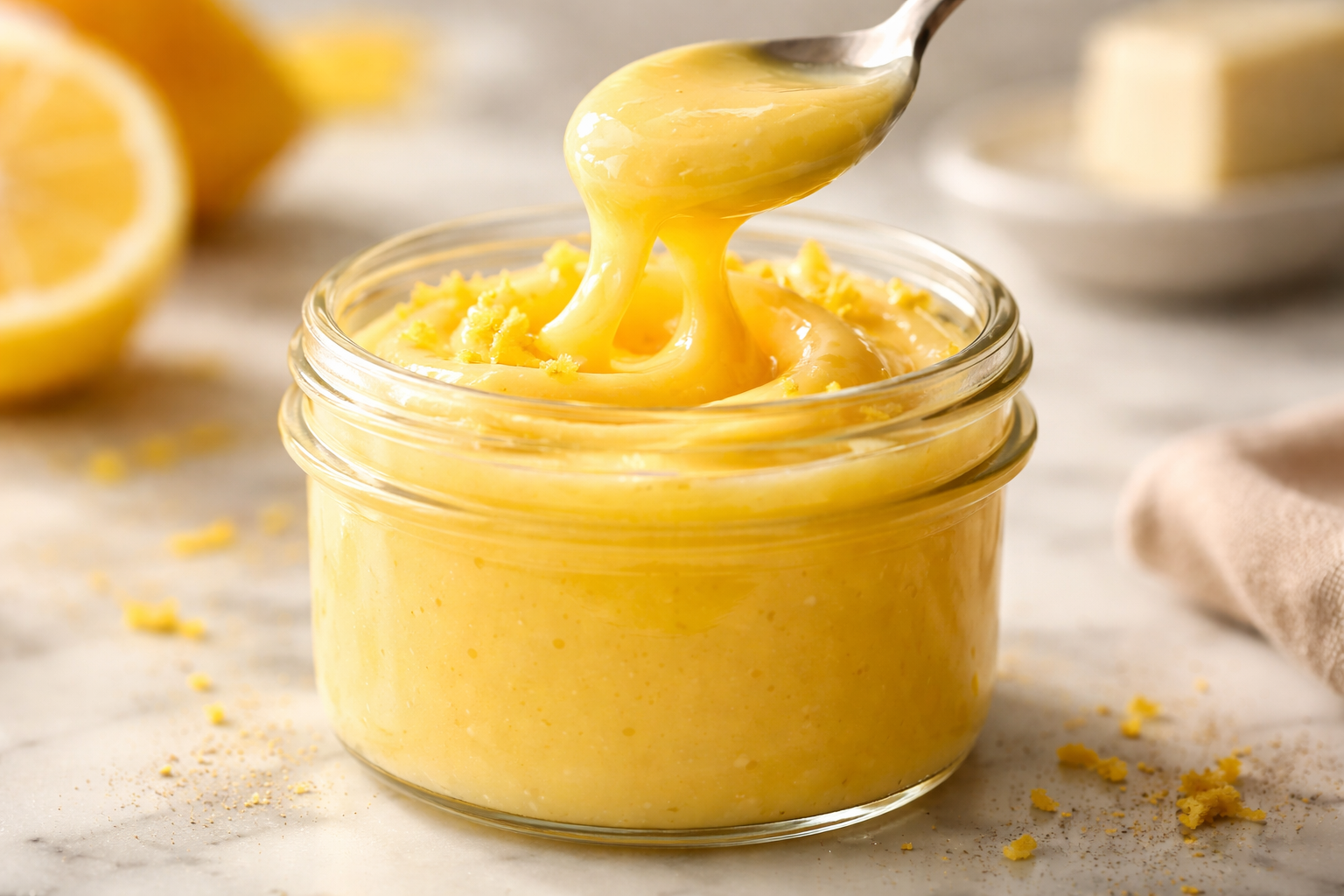
Ingredients
Method
- Prepare the lemons by washing and drying them well. Finely zest the lemons first, then juice them until you have 1/2 cup of juice. Set the zest and juice aside separately.
- In a medium, heavy-bottomed saucepan off the heat, whisk together the whole eggs, egg yolks, sugar-free sweetener, and salt until the mixture is smooth and slightly lightened in color.
- Whisk in the lemon juice and lemon zest until fully combined. The mixture will be thin and foamy.
- Place the saucepan over low to medium-low heat. Cook the mixture, whisking constantly and making sure to reach the edges and corners of the pan so the eggs do not curdle.
- Continue cooking and whisking for 8–12 minutes, or until the curd thickens enough to coat the back of a spoon and a clear line holds when you run your finger through it. Do not let the mixture come to a full boil; if it starts to steam heavily or bubble, reduce the heat.
- Once thickened, remove the saucepan from the heat. Immediately add the butter pieces, whisking until the butter is fully melted and the curd is glossy and smooth. Taste and, if desired, whisk in an extra tablespoon or two of sweetener while the curd is still warm.
- For an ultra-smooth curd, pour the mixture through a fine-mesh sieve into a clean bowl, pressing gently with a spatula to catch any bits of cooked egg or zest.
- Press a piece of plastic wrap directly onto the surface of the warm curd to prevent a skin from forming. Let it cool to room temperature, then refrigerate for at least 2 hours, or until fully chilled and thickened.
- Once chilled, remove the plastic wrap, whisk the curd briefly to smooth it out, and transfer to a clean jar or airtight container. Store in the refrigerator until ready to use.
Notes
Use fresh, unwaxed lemons for the best flavor; the zest carries most of the aroma, so do not skip it.
Allulose tends to give the smoothest, least grainy texture; erythritol blends may crystallize slightly after chilling but can usually be smoothed by whisking before serving.
If your lemons are very tart, hold back 1–2 tablespoons of juice and taste the warm curd before adding more.
For a looser, more spoonable curd, use 3 whole eggs and omit the extra yolks; for a firmer tart filling, keep the extra yolks as written.
Store the curd in an airtight container in the refrigerator for up to 1 week. For longer storage, freeze for up to 2 months and thaw overnight in the fridge.
Serve over yogurt, pancakes, waffles, berries, low-carb toast, or use as a filling for tart shells and cake layers.
Allulose tends to give the smoothest, least grainy texture; erythritol blends may crystallize slightly after chilling but can usually be smoothed by whisking before serving.
If your lemons are very tart, hold back 1–2 tablespoons of juice and taste the warm curd before adding more.
For a looser, more spoonable curd, use 3 whole eggs and omit the extra yolks; for a firmer tart filling, keep the extra yolks as written.
Store the curd in an airtight container in the refrigerator for up to 1 week. For longer storage, freeze for up to 2 months and thaw overnight in the fridge.
Serve over yogurt, pancakes, waffles, berries, low-carb toast, or use as a filling for tart shells and cake layers.